
Articles, Research, Surveys and other useful material for proponents of new traditional architecture:
Research
Traditional architecture gives better sense of well-being than contemporary glass and steel buildings (VR-survey by NMBU, Norwegian University of Life Sciences)
Pedestrians’ perceptions of route environments in relation to deterring or facilitating walking Swedish research what determines why people choose to walk. Natural or architectural beauty is most important factor.
An Evidence-based Examination of the Modernism Program: The Case of Sweden:
An examination of the negative consequences that modernist housing had on health and well being by Dr Gösta Alfvén, Karolinska Institute, Stockholm, Sweden.
Measured beauty? (Finish eye tracking study what makes a facade attractive for the mind) with article about the findings here.
Which architectural style makes an attractive street scape? Aesthetic preferences among city centre managers: Based on a sample of 109 respondents, measuring the architectural preferences of city centre managers, this study indicates that city centre managers view classical architecture in terms of being better for city centres than modernist.
Klassieke architectuur is hét wapen in de strijd tegen online winkelen dutch article about above research.
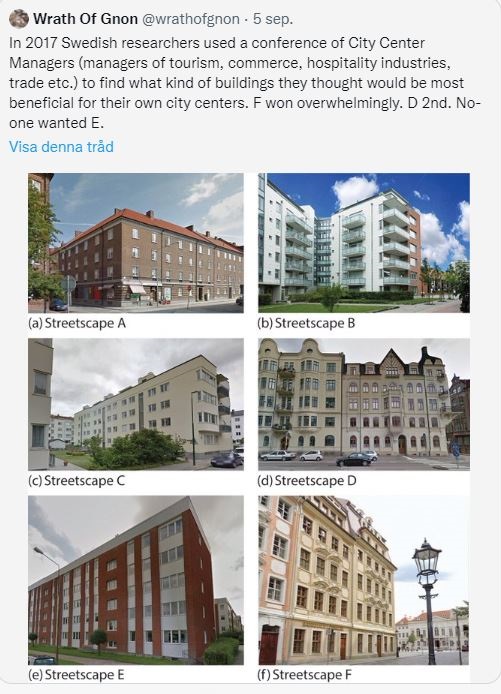
Images of the Small Town – on Aesthetic Evaluation of a Townscape The thesis’ overarching question is: What is it that makes the small town-like habitation much appreciated by lay people, and so controversial among architects?
Modern architecture is an eyesore – even babies can see that article in Telegraph citing this research: The edge orientation entropy of natural scenes is associated with infant visual preferences and adult aesthetic judgements. “The finding that infants look longer at the building façades the more pleasant adults find them extends prior research which has also found associations of infant looking and adult aesthetic judgements for other types of stimuli”.
Architectural design, visual attention, and human cognition: exploring responses to federal building styles This article examines the ongoing architectural debate surrounding styles for American government buildings. It tests the results of the 2020 National Civic Art Society survey that found 72% of Americans prefer traditional federal buildings over modern designs.
An Investigation of the Perception of Neoclassical, Eclectic, Modernist, and Postmodern Architecture within Different Urban Landscapes: Athens vs. Paris The public perception of buildings belonging to different architectural movements is a largely unexplored area from a quantitative scientific perspective. However, a better scientific understanding of perceptions of architectural movements is important for the formation of improved planning and design policies. In this work, we carry out an initial exploration of the public preferences of the architectural movements of Neoclassicism, Eclecticism, Modernism, and Postmodernism.
Der Wert schöner Wohnquartiere (Value of beautiful built environment) study of value development depending on choice of architecture by by Prof Thießen at TU Chemnitz.
Modernisierung historischer Bauten (Modernisation of historic buildings study of value development depending if classical or modernist by Pantera Immobilien.
Die größte Bauwende seit dem Kaiserreich: Longer article in German newspaper Die Welt about how more and more architects understand that the classical tradition is more ecological sustainable not the least because of its beauty.
What Happens in Your Brain When You Walk Down the Street? Implications of Architectural Proportions, Biophilia, and Fractal Geometry for Urban Science this article reviews current research in visual urban perception. The temporal sequence of the first few milliseconds of visual stimulus processing sheds light on the historically ambiguous topic of aesthetic experience.
Architectural Beauty: Developing a Measurable and Objective Scale ..the concept of beauty, as understood by the non-architect, has recently been making a comeback in architecture, not so much in the practice itself, as in appeals for design solutions that are more human-centered and not dictated by abstract principles. Architectural beauty needs to be evaluated from its effects on human health. This study discusses two diagnostic tools for measuring the degree of architectural “beauty” and presents the results of the pilot application of one of them.
AI, the beauty of places, and the metaverse: beyond “geometrical fundamentalism” ..Virtual Reality constitutes a new kind of human environment, and experiencing it relies upon human neurological mechanisms evolved to negotiate — and survive in — our ancestral physical environments. Despite the unrestricted freedom of designing the virtual universe, interacting with it is affected strongly by the body’s built-in physiological and psychological constraints. The eventual success of the metaverse will be determined by how successfully its designers manage to accommodate unconscious mechanisms of emotional attachment and wellbeing.
Study finds that by age 3 kids prefer nature’s fractal patterns Before their third birthdays, children already have an adult-like preference for visual fractal patterns commonly seen in nature, report University of Oregon researchers.
Visual Discomfort in the Built Environment: Leveraging Generative AI and Computational Analysis to Evaluate Predicted Visual Stress in Architectural Façades Can a building make you feel uncomfortable – even unwell – without your full awareness of the reason? According to a new study by researchers from the University of Cambridge and their collaborators, the answer is yes – and the reason may lie in how your brain unconsciously processes the visual patterns of architectural design.
Naturnahe, fraktale Architektur fördert Wohlbefinden Fractals and nature-related design promotes measurable physical and mental well-being.
De waarde van stijl – Een prijsanalyse van historiserende bouwstijlen Dutch research showing that the public at large prefer traditional building designs.
Så får du ett rum på köpet i innerstaden Study by Swedish newspaper SvD that shows that everything else equal, classical is much more sought after than modernist and it shows in real estate prices.
Nyklassiskt i Nacka lockar – trots hög hyra Article that show how building classical is profit maximizing in the Swedish context where it is still very rare.
Polls
Classical or Modern Architecture? For Americans, It’s No Contest (article about a 2020 survey of preference of federal buildings) see also this explanatory blog post Survey Shows Americans Prefer Classical Architecture for Federal Buildings
84% of the public prefer classical architecture, quote from survey by Create Streets & Prince’s Foundation For Building Community. Read the full report here: Housing Communities: What People Want.
71% of Britons prefer a traditional alternative to the current design for the Christ’s College library. Survey Deltapoll and Create Streets.
77% prefer a new classical building if built nearby, results from survey by Yougov
Folkviljan har talat – arkitekterna har fel Swedish survey of architecture preference among the public
Ny studie: Klassisk stil dominerar Swedish survey in 2024 by SOM-institute showing that 66% of public prefer classical architecture to modernist architecture.
Which type of architecture does the Norweigan pulic prefer? Survey by Norstat, Norway largest statistical survey company.


 New Traditional Architecture & Urbanism